A Fiqh Siyasah Analysis of Election Campaigns on Social Media Based on General Election Commission Regulation No. 23 of 2018 on Election Campaigns

DOI:
https://doi.org/10.61842/swq/v1i1.3
Keywords:
Fiqh Siyasah Social Media Campaigns
Abstract
Based on the General Election Commission Regulation (PKPU) of the Republic of Indonesia No. 23 of 2018 on Election Campaigns, Article 35 paragraphs 1 to 4 regulates campaigns on social media. Paragraph 1 states, "Election participants may conduct campaigns through social media as referred to in Article 23 paragraph (1) letter e." Social media is widely used to disseminate information, often without verifying its accuracy, and is prone to fake news and hate speech. The increasing use of social media in Indonesia reflects its growing influence. This study examines: 1) How election campaigns on social media are regulated under PKPU No. 23 of 2018, and 2) How these campaigns align with Fiqh Siyasah. The qualitative research adopts a library research method with a descriptive-analytical approach, using secondary sources like legal texts and academic references. The findings reveal that PKPU No. 23 of 2018 requires participants to register official campaign accounts, limiting them to a maximum of ten accounts per platform. These accounts must be registered no later than one day before the campaign period starts and deactivated on the last day. From the Fiqh Siyasah perspective, social media campaigns are permissible if they avoid slander, adhere to ethical values, and comply with regulations like PKPU No. 23 of 2018. The regulation supports the effective dissemination of campaign information, such as candidates’ visions and missions, while minimizing falsehoods, hate speech, and other violations. This ensures campaigns align with Islamic principles, focusing on public benefits (maslahah). Anything promoting maslahah is permissible in Islam, showing how the regulation fosters positive outcomes for society. PKPU No. 23 of 2018 demonstrates the compatibility between ethical governance and Fiqh Siyasah, balancing modern electoral practices with Islamic values.
References
Al munawwir, Kamus al munawwir Pustaka Progresif 2004
AL-Mawaridi, al ahkam AL sulthaniyyah Haramain : Surabaya, 2017
Ardha Berliani, Sosial Media sebagai Media Kampanye Partai Politik 2014 di Indonesia, Jurnal Visi Komunikasi, Vol.13, No. 01, Mei 2014
Asshsubli, prespektif Hukum Islam Terhadap Pencalonan Diri dan Kampanye Untuk Jabatan Politik Vol 21, Sumatera Barat Institut Agama Islam Negeri Batusangkar, 2022
Anis Hidayati, Kampanye Pemilihan Umum Preseden dan Wakil Preseden Persepektif Fikih Siyasah, Jurnal Hukum dan Perundangan Islam. Vol 5 No. 1 al-daulah April 2015
Abdul wahhab khallaf, al-siyasah al-syar'iyyah, Kairo : Mu’assasah Al-Arabiyah, 1961
Abdurrahman taj, al-siyasah al-syar'iyyah wa al-fiqh al-islami, Kairo : Mu’assasah Al-Arabiyah, 1961
Berliani Ardha, Social Media Sebagai Media Kampanye Partai Politik 2014 Di Indonesia, Jurnal Visi Komunikasi, Vol 13., No. 01, Mei 2014
Djazuli, Fiqh Siyasah Implementasi Kemaslahatan Umat Dalam Rambu-Rambu Syariah, Jakarta: Kencana Prenada Media Grup, 2009
Imam al-Mawardi, Hukum - Hukum Penyelenggaraan Negara dalam Syariat Islam, Terj. Fadli Bahri dalam Al - Ahkam As -Sulthaniyyah, Jakarta: Darul Falah, 2006
Jalalain, Tafsir Jalalain , jilid 4 Haramain : Surabaya, 2017
Khairul Fahmi, Pemilihan Umum Dan Kedaulatan Rakyat, Jakarta: Raja Grafindo Persada, 2011
Lidwa Pustaka, Kitab 9 Imam Hadits, Sunan Nasa‟i, Hadits Nomor 5289.
Muhammad Iqbal, Fiqh Siyasah Kontekstualisasi Doktrin Politik Islam, Cet Ke 1, Jakarta : Gaya Media Pratama, 2001
Ramlan Surbakti.Memahami Ilmu Politik. Jakarta: PT.Grasindo, 1992
Siti Fatimah, Kampanye sebagai Komunikasi Politik: Esensi dan Strategi dalam Pemilu. Resolusi Vol. 1 No. 1 Juni 2018
UUD NRI 1945 pasal 22E
Undang-undang Nomor 8 Tahun 2012 Tentang Pemilihan Umum
Zakariyya al ansari Ghayah usul ( Haramain : Surabaya, 2017 )
https://www.medcom.id/pilkada/news-pilkada/VNxvG1dk-17-kasus-dugaan-pelanggaran-pilkada-ditemukan-di-media-sosial. Diakses tanggal 8/11/2022
https://www.kominfo.go.id/content/detail/14795/mengatur-kampanye-di-mediasosial/0/sorotan_media#:~:text=Dalam%20Peraturan%20KPU%20(PKPU)%20Nomor,kampanye%20paling%20banyak%2010%20akun. (Di Akses Pada 15 februari 2023)

Downloads
Published
2023-06-05
Statistic
-
Read Counter : 403
Download : 395
Download data is not yet available.
Issue
Section
Articles
How to Cite
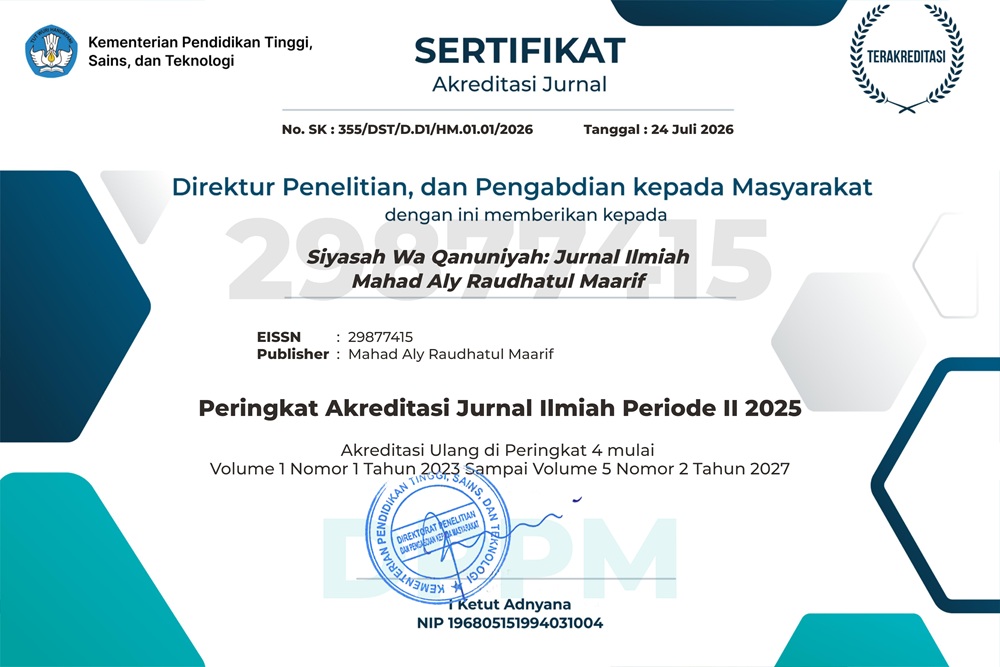
Muhammad Fadhli. (2023). A Fiqh Siyasah Analysis of Election Campaigns on Social Media Based on General Election Commission Regulation No. 23 of 2018 on Election Campaigns. Siyasah Wa Qanuniyah : Jurnal Ilmiah Ma’had Aly Raudhatul Ma’arif, 1(1), 34–48. https://doi.org/10.61842/swq/v1i1.3
License
Copyright (c) 2023 Muhammad Fadhli

This work is licensed under a Creative Commons Attribution 4.0 International License.
You are accessible to:
Share — copy and redistribute the material in any medium or format
Adapt — remix, transform, and build upon the material for any purpose, even commercially
Under the following terms:
Attribution — You must give appropriate credit, provide a link to the license, and indicate if changes were made. You may do so reasonably but not in any way that suggests the licensor endorses you or your use.
ShareAlike — If you remix, transform, or build upon the material, you must distribute your contributions under the same license as the original
No additional restrictions — You may not apply legal terms or technological measures that legally restrict others from doing anything the license permits
DOI:
https://doi.org/10.61842/swq/v1i1.3Keywords:
Fiqh Siyasah Social Media CampaignsAbstract
Based on the General Election Commission Regulation (PKPU) of the Republic of Indonesia No. 23 of 2018 on Election Campaigns, Article 35 paragraphs 1 to 4 regulates campaigns on social media. Paragraph 1 states, "Election participants may conduct campaigns through social media as referred to in Article 23 paragraph (1) letter e." Social media is widely used to disseminate information, often without verifying its accuracy, and is prone to fake news and hate speech. The increasing use of social media in Indonesia reflects its growing influence. This study examines: 1) How election campaigns on social media are regulated under PKPU No. 23 of 2018, and 2) How these campaigns align with Fiqh Siyasah. The qualitative research adopts a library research method with a descriptive-analytical approach, using secondary sources like legal texts and academic references. The findings reveal that PKPU No. 23 of 2018 requires participants to register official campaign accounts, limiting them to a maximum of ten accounts per platform. These accounts must be registered no later than one day before the campaign period starts and deactivated on the last day. From the Fiqh Siyasah perspective, social media campaigns are permissible if they avoid slander, adhere to ethical values, and comply with regulations like PKPU No. 23 of 2018. The regulation supports the effective dissemination of campaign information, such as candidates’ visions and missions, while minimizing falsehoods, hate speech, and other violations. This ensures campaigns align with Islamic principles, focusing on public benefits (maslahah). Anything promoting maslahah is permissible in Islam, showing how the regulation fosters positive outcomes for society. PKPU No. 23 of 2018 demonstrates the compatibility between ethical governance and Fiqh Siyasah, balancing modern electoral practices with Islamic values.
References
Al munawwir, Kamus al munawwir Pustaka Progresif 2004
AL-Mawaridi, al ahkam AL sulthaniyyah Haramain : Surabaya, 2017
Ardha Berliani, Sosial Media sebagai Media Kampanye Partai Politik 2014 di Indonesia, Jurnal Visi Komunikasi, Vol.13, No. 01, Mei 2014
Asshsubli, prespektif Hukum Islam Terhadap Pencalonan Diri dan Kampanye Untuk Jabatan Politik Vol 21, Sumatera Barat Institut Agama Islam Negeri Batusangkar, 2022
Anis Hidayati, Kampanye Pemilihan Umum Preseden dan Wakil Preseden Persepektif Fikih Siyasah, Jurnal Hukum dan Perundangan Islam. Vol 5 No. 1 al-daulah April 2015
Abdul wahhab khallaf, al-siyasah al-syar'iyyah, Kairo : Mu’assasah Al-Arabiyah, 1961
Abdurrahman taj, al-siyasah al-syar'iyyah wa al-fiqh al-islami, Kairo : Mu’assasah Al-Arabiyah, 1961
Berliani Ardha, Social Media Sebagai Media Kampanye Partai Politik 2014 Di Indonesia, Jurnal Visi Komunikasi, Vol 13., No. 01, Mei 2014
Djazuli, Fiqh Siyasah Implementasi Kemaslahatan Umat Dalam Rambu-Rambu Syariah, Jakarta: Kencana Prenada Media Grup, 2009
Imam al-Mawardi, Hukum - Hukum Penyelenggaraan Negara dalam Syariat Islam, Terj. Fadli Bahri dalam Al - Ahkam As -Sulthaniyyah, Jakarta: Darul Falah, 2006
Jalalain, Tafsir Jalalain , jilid 4 Haramain : Surabaya, 2017
Khairul Fahmi, Pemilihan Umum Dan Kedaulatan Rakyat, Jakarta: Raja Grafindo Persada, 2011
Lidwa Pustaka, Kitab 9 Imam Hadits, Sunan Nasa‟i, Hadits Nomor 5289.
Muhammad Iqbal, Fiqh Siyasah Kontekstualisasi Doktrin Politik Islam, Cet Ke 1, Jakarta : Gaya Media Pratama, 2001
Ramlan Surbakti.Memahami Ilmu Politik. Jakarta: PT.Grasindo, 1992
Siti Fatimah, Kampanye sebagai Komunikasi Politik: Esensi dan Strategi dalam Pemilu. Resolusi Vol. 1 No. 1 Juni 2018
UUD NRI 1945 pasal 22E
Undang-undang Nomor 8 Tahun 2012 Tentang Pemilihan Umum
Zakariyya al ansari Ghayah usul ( Haramain : Surabaya, 2017 )
https://www.medcom.id/pilkada/news-pilkada/VNxvG1dk-17-kasus-dugaan-pelanggaran-pilkada-ditemukan-di-media-sosial. Diakses tanggal 8/11/2022
https://www.kominfo.go.id/content/detail/14795/mengatur-kampanye-di-mediasosial/0/sorotan_media#:~:text=Dalam%20Peraturan%20KPU%20(PKPU)%20Nomor,kampanye%20paling%20banyak%2010%20akun. (Di Akses Pada 15 februari 2023)
Downloads
Published
Statistic
- Read Counter : 403 Download : 395
Issue
Section
How to Cite
License
Copyright (c) 2023 Muhammad Fadhli

This work is licensed under a Creative Commons Attribution 4.0 International License.
You are accessible to:
Share — copy and redistribute the material in any medium or format
Adapt — remix, transform, and build upon the material for any purpose, even commercially
Under the following terms:
Attribution — You must give appropriate credit, provide a link to the license, and indicate if changes were made. You may do so reasonably but not in any way that suggests the licensor endorses you or your use.
ShareAlike — If you remix, transform, or build upon the material, you must distribute your contributions under the same license as the original
No additional restrictions — You may not apply legal terms or technological measures that legally restrict others from doing anything the license permits
 Make a Submission
  Manuscript Template