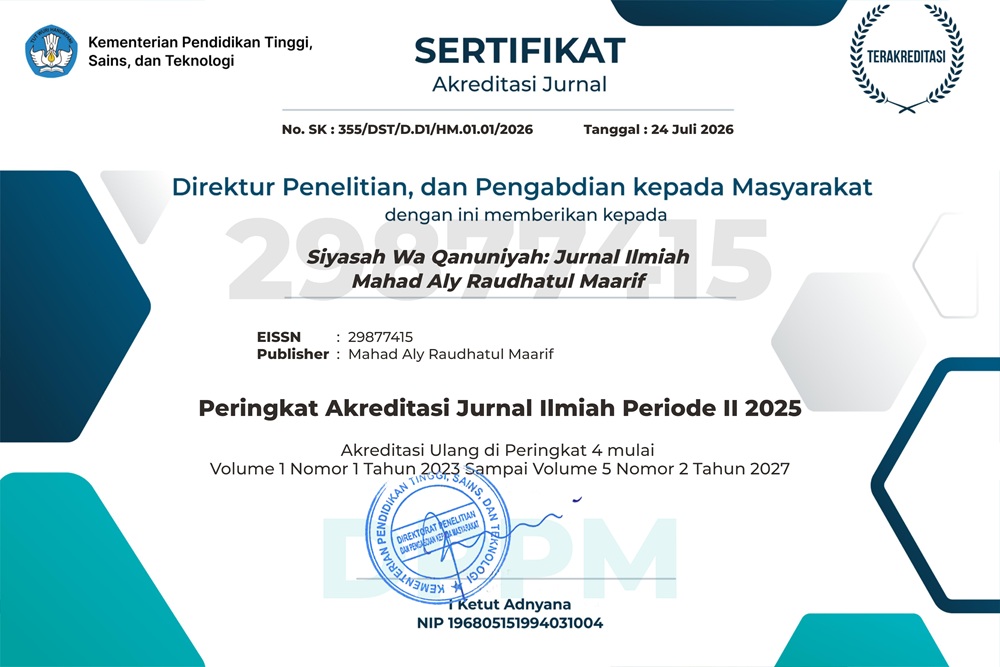
National Accreditation
SINTA 4
ACTIVESiyasah Wa Qanuniyah has officially been awarded SINTA 4 (Accreditation Rank 4) under the Decree No. 355/DST/D.D1/HM.01.01/2026. The accreditation is valid from Vol.1 No.1 (2023) through Vol.5 No.2 (2027).

Journal Siyasah Wa Qanuniyah is strictly committed to maintaining the highest level of academic integrity and originality in every published manuscript. Plagiarism, in any form, constitutes unethical publishing behavior and is unacceptable. Therefore, all submitted manuscripts will undergo a rigorous plagiarism screening process as part of the initial editorial evaluation before proceeding to the peer-review stage.
Total Similarity Rate: Submitted manuscripts must have a total similarity index of no more than 35%.
Exclusions: This similarity rate is calculated by excluding the bibliography/references and properly formatted direct quotes.
Single-Source Limit: To prevent block-copying, the similarity rate from any single individual source must not exceed 5%.
Use of Detection Software: Every submitted manuscript will be thoroughly checked by the editorial team using industry-standard plagiarism detection software (such as Turnitin or iThenticate).
Author's Self-Report: As stated in the Author Guidelines, authors are highly encouraged to attach their own plagiarism check report as a supplementary file during submission to expedite the initial screening process.
Revision Opportunity: If a manuscript exceeds the 35% threshold or violates the single-source limit, it will be returned to the authors. Authors will be given a designated timeframe to revise and paraphrase the highlighted sections to reduce the similarity rate to an acceptable level.
Self-Plagiarism (Text Recycling): Authors must avoid self-plagiarism. Reusing substantial parts of one's own previously published work without proper citation is prohibited.
Manuscript Rejection: Manuscripts that fail to meet the maximum plagiarism limit after the revision period will be outright rejected and removed from the publication workflow.
Pre-Publication: The editorial board reserves the right to immediately reject manuscripts that exhibit severe, deliberate plagiarism (e.g., copying entire pages from another source) without offering a revision opportunity.
Post-Publication (Retraction): If plagiarism or a severe breach of academic ethics is detected after a manuscript has been published, the journal will follow the COPE guidelines. Corrective actions will be taken immediately, which include a formal Article Retraction. An official notice of retraction will be published, and a notification may be sent to the authors’ affiliated institutions or funding bodies.
Authors must continuously uphold academic ethical principles by ensuring their submitted work is entirely original. Any ideas, data, theoretical concepts, or exact phrasing drawn from other works—including the author's own previous publications—must be appropriately attributed and cited following the Chicago Manual of Style 17th Edition (Full Note).
By adhering to these guidelines, authors collaborate with the editorial team to maintain the academic integrity and scientific reputation of Journal Siyasah Wa Qanuniyah.



Copyright (c) 2023 Siyasah Wa Qanuniyah | Jurnal Ilmiah Ma'had Aly Raudhatul Ma'arif | This work is licensed under a Creative Commons Attribution 4.0 International License
 Make a Submission
  Manuscript Template