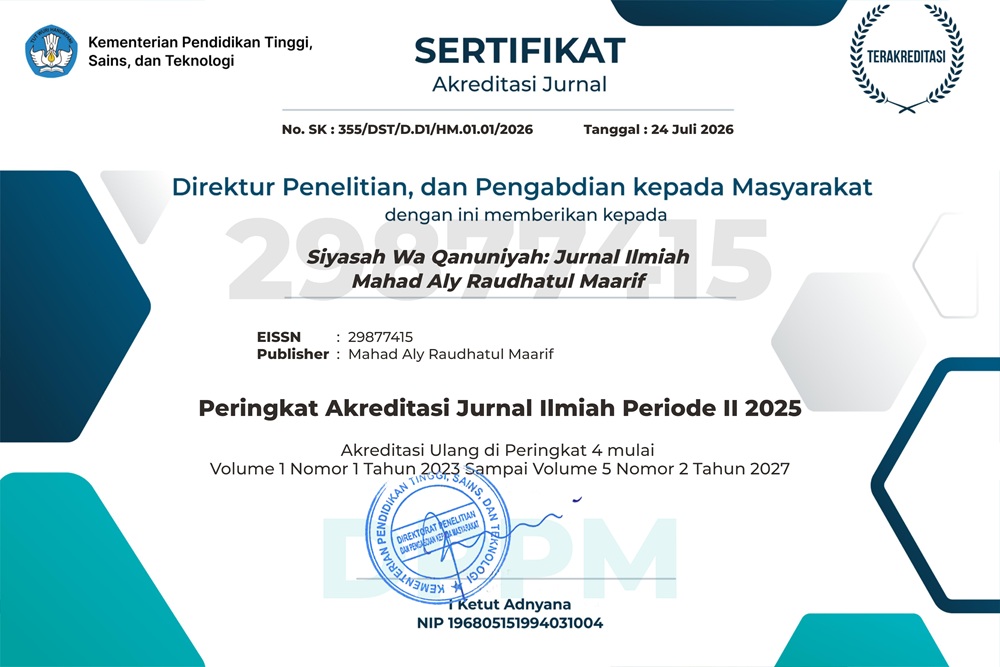
National Accreditation
SINTA 4
ACTIVESiyasah Wa Qanuniyah has officially been awarded SINTA 4 (Accreditation Rank 4) under the Decree No. 355/DST/D.D1/HM.01.01/2026. The accreditation is valid from Vol.1 No.1 (2023) through Vol.5 No.2 (2027).

This section contains original research articles that have never been published before and are not currently under evaluation in other journals. Articles should make a significant scientific contribution to the field of study that is the focus of this journal. Manuscripts are written systematically with a general structure: introduction, method, results and discussion, and conclusion. Each article will go through a double-blind peer-review process by at least two independent reviewers.
Authors are expected to include a relevant bibliography and follow a predetermined journal writing template.
This section contains critical reviews of recent books relevant to the focus and scope of the journal. Reviews can include analysis of the content, approach, methodology, scientific contribution, and relevance of the book to the development of certain fields of study.
The reviewer is expected to convey an objective assessment, include complete bibliographic information, and provide clear arguments regarding the advantages and disadvantages of the book being reviewed.
The book reviewed should be published within the last 5 years and not be the author's own work.
Authors who publish with Journal Siyasah Wa Qanuniyah agree to the following terms:
Authors retain full copyright and publishing rights over their work without any restrictions.
Authors grant the journal the right of first publication. Upon publication, the work is simultaneously licensed under a Creative Commons Attribution 4.0 International License (CC BY 4.0).
Under this license, anyone is free to:
Share — copy and redistribute the material in any medium or format.
Adapt — remix, transform, and build upon the material for any purpose, even commercially.
Under the following terms:
Attribution — Users must give appropriate credit, provide a link to the license, and indicate if changes were made. This may be done in any reasonable manner, but not in any way that suggests the licensor endorses the user or their use.
No additional restrictions — Users may not apply legal terms or technological measures that legally restrict others from doing anything the license permits.
Authors are permitted to enter into separate, additional contractual arrangements for the non-exclusive distribution of the journal's published version of the work. This includes posting the article to an institutional repository, archiving it in a subject-based repository, or publishing it as a book chapter. Any such distribution must include a clear acknowledgment of the work's initial publication in Journal Siyasah Wa Qanuniyah and provide a link to the article's official DOI.
Authors are permitted and highly encouraged to post their work online (e.g., in institutional repositories, pre-print servers, or on personal websites) both prior to and during the submission process. This practice facilitates productive academic exchanges and significantly increases the likelihood of earlier and broader citations of the published work.
Note for Authors: Once the manuscript is officially published in the journal, authors are responsible for updating any prior online postings (such as pre-prints) to include the final citation details and a link to the published article's DOI.
The names and email addresses entered in this journal site will be used exclusively for the stated purposes of this journal and will not be made available for any other purpose or to any other party.



Copyright (c) 2023 Siyasah Wa Qanuniyah | Jurnal Ilmiah Ma'had Aly Raudhatul Ma'arif | This work is licensed under a Creative Commons Attribution 4.0 International License
 Make a Submission
  Manuscript Template