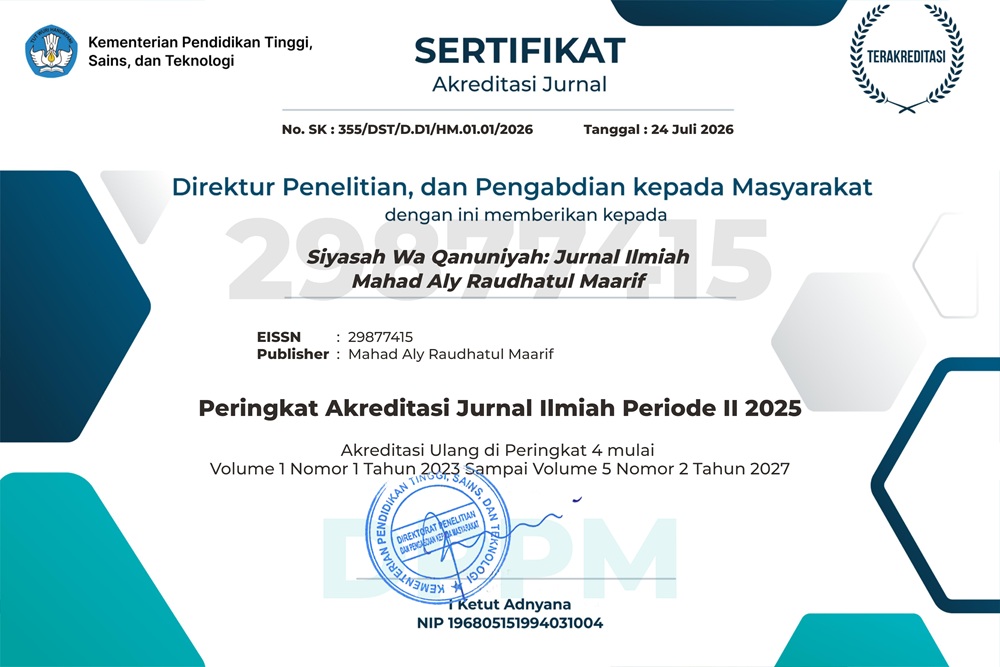
National Accreditation
SINTA 4
ACTIVESiyasah Wa Qanuniyah has officially been awarded SINTA 4 (Accreditation Rank 4) under the Decree No. 355/DST/D.D1/HM.01.01/2026. The accreditation is valid from Vol.1 No.1 (2023) through Vol.5 No.2 (2027).

Journal Siyasah Wa Qanuniyah focuses on scholarly studies in the field of Islamic politics (siyasah) and Islamic law (qanuniyah), both from theoretical and empirical perspectives. The journal aims to become a forum for academic dialogue and research dissemination on Islamic political thought, constitutional law, public policy, and governance based on Islamic values.
The publication of an article in this journal represents an important contribution to the development of legal and political studies based on Islamic principles. It reflects the quality of the authors’ work and the institutions that support them. Therefore, all parties involved—authors, editors, reviewers, and publishers—are expected to uphold ethical standards in every stage of publication, guided by the Core Practices of the Committee on Publication Ethics (COPE).
This journal publishes two issues in every volume, scheduled twice a year (June and December).
Journal Siyasah Wa Qanuniyah provides immediate open access to its content based on the principle that making research freely available to the public supports a greater global exchange of knowledge. Readers may read, download, copy, distribute, print, or link to the full texts of articles without prior permission from the publisher or author. The journal does not charge any fees for article submission or publication (Article Submission and Publication Fees are Free), ensuring that financial constraints do not hinder academic contributions.
Editorial Independence Ma’had Aly Raudhatul Ma’arif, as the publisher of Journal Siyasah Wa Qanuniyah, is committed to ensuring that advertising, reprint, or other commercial revenue has no impact or influence on editorial decisions. The publisher safeguards the editorial independence of the journal's editorial board.
Support for Scientific Integrity The publisher works closely with the Editor-in-Chief and the editorial board to set and enforce journal policies, particularly those concerning research and publication ethics. The publisher will assist in investigating any suspected or alleged research or publication misconduct.
Corrections and Retractions The publisher is always prepared to publish corrections, clarifications, retractions, and apologies when necessary to maintain the integrity of the academic record.
Archiving and Access The publisher is responsible for the digital preservation of the journal's content and ensuring equitable, open access to the published articles for the global academic community.
Publication Decisions The editor of Journal Siyasah Wa Qanuniyah is responsible for deciding which submitted manuscripts are suitable for publication based on their academic merit, originality, and relevance to the journal’s scope. Editors may consult with reviewers or the editorial board when making these decisions and must comply with applicable laws regarding libel, copyright, and plagiarism. The publisher ensures that no commercial or financial considerations influence editorial decisions.
Fair Play Editors evaluate manuscripts solely on intellectual content without regard to the authors’ race, gender, religion, nationality, or political ideology.
Confidentiality Editors and editorial staff must not disclose any information about submitted manuscripts to anyone other than the corresponding author, reviewers, potential reviewers, and the publisher.
Disclosure and Conflicts of Interest Unpublished materials disclosed in a submitted manuscript must not be used by editors in their own research without the author’s express written consent.
Contribution to Editorial Decisions Peer review assists editors in making editorial decisions and may help authors improve their papers through constructive feedback. The journal operates under a double-blind review process, where the identities of both authors and reviewers are kept confidential.
Promptness Reviewers who feel unqualified to evaluate a manuscript or unable to complete the review in a timely manner must inform the editor and withdraw from the review process.
Confidentiality All manuscripts received for review must be treated as confidential and must not be shared or discussed with others except as authorized by the editor.
Objectivity Reviews should be objective, and personal criticism of the author is inappropriate. Referees should provide clear, evidence-based feedback to help authors improve their manuscript.
Acknowledgment of Sources Reviewers should identify uncited relevant work and inform the editor of any substantial similarity or overlap between the manuscript under consideration and any other published papers.
Conflict of Interest Reviewers must not use privileged information for personal gain and should decline to review manuscripts where conflicts of interest exist.
Reporting Standards Authors should present accurate, original, and clear descriptions of their research. Underlying data should be represented accurately. Fraudulent or knowingly inaccurate statements constitute unethical behavior and are unacceptable.
Originality and Plagiarism Authors must ensure their work is entirely original and appropriately cite or quote the works of others. Plagiarism in all its forms constitutes unethical publishing behavior.
Multiple, Redundant, or Concurrent Publication Authors should not submit the same manuscript to more than one journal concurrently. Publishing manuscripts describing essentially the same research in more than one journal is unethical.
Use of AI and AI-Assisted Technologies Authors must transparently disclose the use of generative AI and AI-assisted technologies (e.g., ChatGPT, Claude) in the writing process by adding a statement to their manuscript. These technologies should only be used to improve readability and language quality, not to replace critical authoring tasks such as data analysis, legal interpretation, or drawing conclusions. AI and LLM tools cannot be listed as an author or co-author under any circumstances.
Ethical Clearance and Informed Consent For empirical studies involving human participants (e.g., interviews, field observations), authors must ensure that the research was conducted ethically. Informed consent must be obtained from all participants, and their privacy must be strictly protected.
Authorship of the Paper Authorship should be limited to those who significantly contributed to the conception, design, or interpretation of the study. All co-authors must approve the final version of the paper and agree to its submission.
Disclosure and Conflicts of Interest Authors must disclose any financial or other significant conflicts of interest that might affect the interpretation of their results.
Fundamental Errors in Published Works When an author discovers a major error in their published work, they must promptly notify the editor and cooperate to correct or retract the article.
Journal Siyasah Wa Qanuniyah is committed to maintaining the integrity of the scholarly record. In cases where errors, ethical breaches, or misconduct are identified after publication, the editorial board will take appropriate action.
1. Corrections (Errata and Corrigenda) The journal will issue a correction if an honest error is discovered that significantly affects the scientific accuracy or metadata of the article. Corrections will be published promptly and linked to the original article to ensure transparency.
2. Retractions An article may be retracted if the editorial board finds conclusive evidence of severe scientific misconduct. Grounds for retraction include, but are not limited to:
Clear evidence of unreliable findings due to misconduct (e.g., data fabrication) or honest error.
Plagiarism or duplicate publication.
Unethical research practices.
The inclusion of AI-generated content presented as human-authored without proper disclosure. When an article is retracted, a formal Notice of Retraction will be published and the original article will be watermarked as "RETRACTED".
3. Handling Unethical Publishing Practices Any allegations of unethical publishing practices will be investigated thoroughly by the editorial team. The journal follows the COPE flowcharts for handling allegations of misconduct. If allegations are proven true, the journal may impose sanctions, ranging from a formal warning and article retraction to a ban on future submissions by the offending authors.



Copyright (c) 2023 Siyasah Wa Qanuniyah | Jurnal Ilmiah Ma'had Aly Raudhatul Ma'arif | This work is licensed under a Creative Commons Attribution 4.0 International License
 Make a Submission
  Manuscript Template